
Recently, community contributor @Cyberleu contributed requirements for aggregate functions such as GROUP BY WITH ROLLUP, GROUP BY WITH CUBE, GROUP BY WITH SETS, and GROUPING to MatrixOne, filling needs related to advanced data aggregation and grouping operations in SQL. Details are as follows.
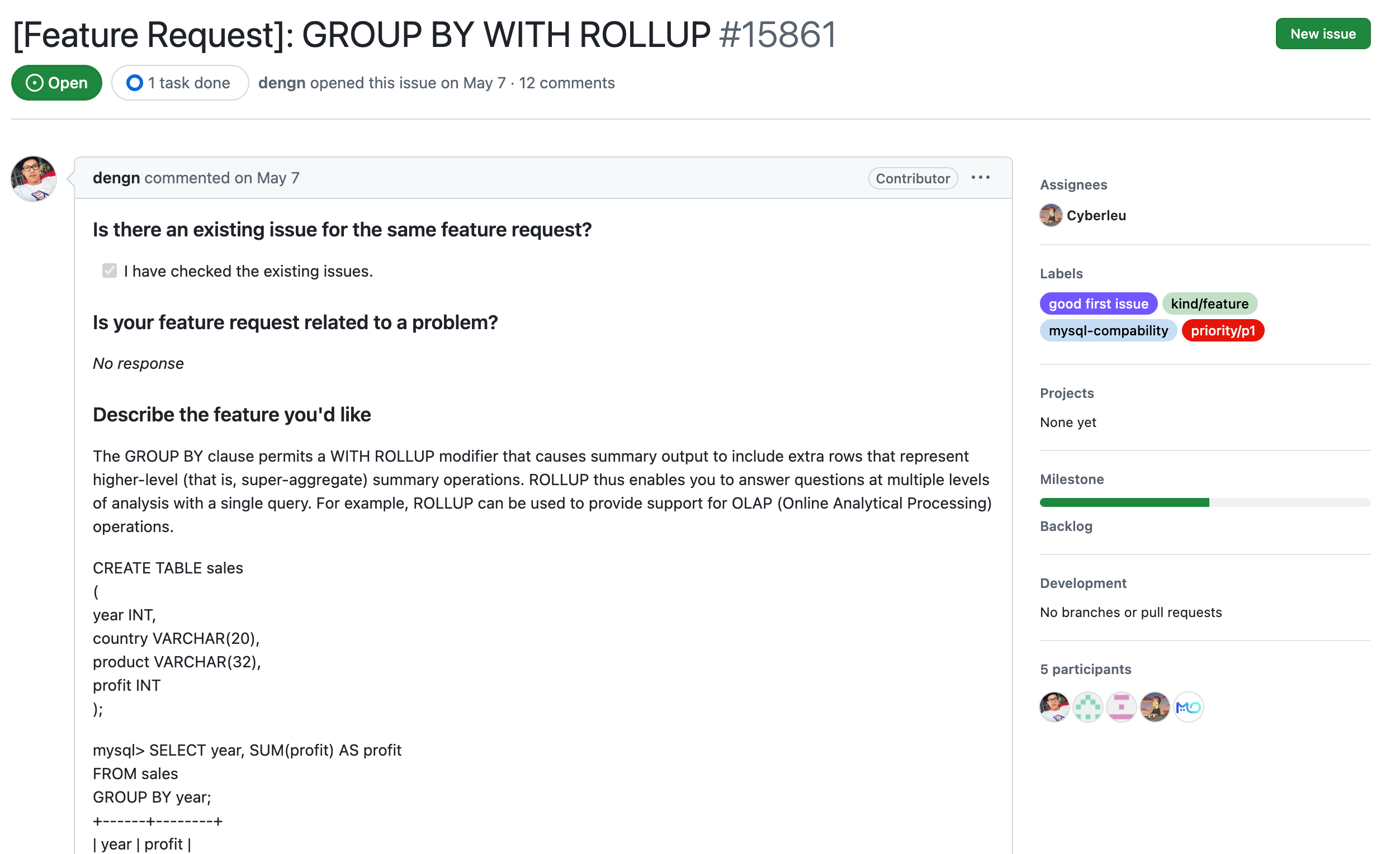
1. GROUP BY WITH ROLLUP
- Problem solved
Performs hierarchical aggregation on data and calculates summary values at each level, as well as the grand total, within the same query.
- Use case
Suitable for scenarios that require step-by-step aggregation, such as summarizing sales by year and quarter and finally producing total sales.
- Example
Annual, quarterly, and monthly sales summaries, with total sales displayed in the final row.
2. GROUP BY WITH CUBE
- Problem solved
Provides comprehensive aggregated data for all combinations of dimensions, generating summaries for every possible grouping in a dataset.
- Use case
Suitable for scenarios that require combined aggregation across multiple dimensions, such as analyzing sales by different combinations of year, company, and product.
- Example
Sales summaries by year, company, and product, while also displaying every possible combination and the overall total.
3. GROUP BY WITH SETS
- Problem solved
Allows multiple grouping sets to be specified so that different grouping combinations can be aggregated within the same query, providing greater flexibility.
- Use case
Suitable for scenarios that require aggregation over specific grouping combinations without generating all possible combinations as CUBE does.
- Example
Only aggregate the year-company combination and the company-product combination, while ignoring other possible combinations.
4. GROUPING (GROUPING SETS)
- Problem solved
Used together with ROLLUP or CUBE, it helps identify the hierarchy or dimension of aggregated results, making it easier to distinguish summary rows at different levels in the query result.
- Use case
Suitable for scenarios where the result needs to distinguish different levels of summary values, such as year, quarter, month, and the grand total.
- Example
Use the GROUPING function to mark which rows are annual summaries, which are quarterly summaries, and which are grand totals.
FeatureRequest
AES_ENCRYPT() and AES_DECRYPT() functions #15911:
- https://github.com/matrixorigin/matrixone/issues/15911
Support alter database #6601:
- https://github.com/matrixorigin/matrixone/issues/6601
DML returning #7501:
- https://github.com/matrixorigin/matrixone/issues/7501
Support reference aliases in where clause #16244:
- https://github.com/matrixorigin/matrixone/issues/16244
Closing
A single spark can start a prairie fire, and the MatrixOne community continues to need more contributors. More issues are looking for contributors, so please follow along. Become a MatrixOne Contributor and receive generous customized gifts from the MatrixOne community!